


One of the biggest advantages of hydroponics is the control you get over your growing environment. Light cycles, watering intervals, ventilation—timing all of these manually gets old fast. That’s where a hydroponic timer steps in.
Whether you’re growing on a shelf, in a grow tent, or managing a small indoor garden, a timer keeps things consistent so your plants stay happy and you don’t miss a beat.
Below is everything beginners need to know about hydroponic timers—plus my top recommended options.
Quick Guide: What a Hydroponic Timer Controls
A good timer can automate one or more parts of your hydroponic setup:
- Lighting schedules – Sets your ON/OFF times for seedling, vegetative, and flowering stages.
- Ventilation cycles – Turns exhaust fans on/off to help regulate temperature and humidity.
- Watering intervals – Especially for ebb & flow systems that flood on a schedule.
- Accessory control – Humidifiers, CO₂ equipment, or circulation fans.
Having these tasks automated means fewer mistakes, fewer interruptions, and much more consistent growth.
How Timers Improve Hydroponic Gardening
Lighting Control
Light duration changes with the plant’s growth stage. For example:
- Seedlings: 16–18 hours
- Leafy greens: 12–16 hours
- Flowering plants: Often 12 hours
A timer keeps this schedule exact—even when you forget or aren’t home.
Ventilation Management
Indoor gardens warm up fast under grow lights. A timer can cycle your exhaust fan every hour, every 30 minutes, or whatever your system needs to keep temperatures stable.
Watering & Nutrient Flow
Hydroponic systems like ebb and flow rely heavily on timing. Too few floods and plants dry out. Too many and the roots can drown.
A timer lets you set precise flooding intervals throughout the day and night.
My Top 5 Hydroponic Timers for Hobby Gardeners
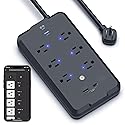
1. Geeni Surge 6-Outlet Smart WiFi Surge Protector
You get 6 individually controllable outlets, full WiFi app scheduling, and built-in energy monitoring so you can track how much power your grow lights, pumps, or fans are using. It’s compatible with Google Assistant and Alexa, but you don’t need a hub or any extra hardware.
For hydroponic gardeners, the biggest benefit is being able to run different schedules on different outlets—lights on one program, fans on another, and accessories on their own timing. It’s essentially a small automation hub in surge-protected power strip form.
If you want maximum control, remote access, and the ability to fine-tune your garden’s schedule from your phone, this is the great all-in-one option for most hobby growers.
Pros
- Six individually controlled smart outlets
- WiFi scheduling through the Geeni app (no hub required)
- Energy monitoring for each outlet
- Voice-assistant compatible (Alexa & Google Assistant)
- Surge protection built in
- Great for controlling multiple devices with different schedules
Cons
- Requires smartphone/app for setup and scheduling
- Needs a stable WiFi connection
 | My Top Pick | 500+ Reviews |
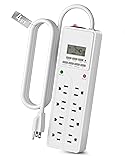
BN-LINK 8 Outlet Surge Protector with 7-Day Digital Timer (4 Timed, 4 Always On)
If you like the idea of combining surge protection with flexible scheduling, this BN-LINK strip is a solid option for small hydroponic gardens.
This strip is especially useful if you want to run your lights and fans on a schedule, while keeping things like air pumps or monitors powered on 24/7. It gives you 8 outlets total:
- 4 timer-controlled outlets for things like grow lights, fans, or pumps
- 4 “always on” outlets for equipment that should never shut off
You can choose specific days of the week or use preset combinations, and there’s even a Daylight Savings Time button so you don’t have to reprogram everything twice a year. A built-in backup battery keeps your schedule saved during power outages.
Pros
- 4 timer-controlled outlets + 4 always-on outlets
- Up to 8 on/off programs with 1-minute minimum interval
- Surge protection for all 8 outlets
- Backup battery preserves settings during outages
- Simple Daylight Savings mode and schedule presets
Cons
- All 4 timer outlets share one schedule (cannot program them independently)
- Indoor use only
 | My Top Pick | 6,600+ Reviews |
3. APC 4-Outlet Wall Surge Protector with Timer
For growers looking to protect their gear and automate a simple schedule, the APC P4GC is a great fit. It combines a 1080-joule surge protector with a built-in timer that controls all four outlets at the same time. That makes it ideal for running a small hydroponic lighting setup or anything that needs to turn on and off together each day.
The timer repeats a 24-hour cycle, and the outlets follow your programmed ON/OFF times automatically. Because everything is synchronized, this unit shines when you want dependable lighting automation without complicated settings or multiple devices.
Pros
- Built-in 1080-joule surge protection
- Great for lighting setups that share one schedule
- Four timer-controlled outlets
- Trusted APC reliability
- Comes with a lifetime warranty
- Includes a $50,000 equipment protection policy from APC
Cons
- All outlets run on a single shared schedule
- No individual outlet control
- Only supports one daily cycle (not weekly programmable)
 | My Top Pick | 6,600+ Reviews |
4. GE 24-Hour Heavy-Duty Indoor Mechanical Timer
If you want a simple, reliable, no-nonsense timer for your hydroponic setup, this GE mechanical timer is one of the best budget options on Amazon. It’s the classic dial-style timer, using 30-minute interval push-pins to create your daily on/off cycle. No learning curve, no menus—just set your times and plug in.
This model includes two grounded outlets, which makes it useful for running a light and a circulation fan together, or any two devices that need the same schedule. It repeats your program every 24 hours and includes a simple override switch when you want to temporarily bypass the timer.
Pros
- Very simple to set—just push down the pins for ON times
- Two outlets for running devices on the same schedule
- 30-minute minimum interval gives reasonable control
- Heavy-duty design suitable for lights and pumps
- Affordable and widely trusted
- Manual override switch for flexibility
Cons
- Only supports one daily repeating schedule
- Both outlets share the same timing (no independent control)
- Mechanical dial means slightly less precision than digital timers
 | My Top Pick | 21,300+ Reviews |
Do You Need a Timer for Your Hydroponic Garden?
If your garden uses grow lights, automated watering, or ventilation, the answer is almost always yes.
Timers:
- Keep your plants on a consistent schedule
- Reduce the chance of mistakes
- Make hydroponics feel much easier
- Help prevent plant stress from inconsistent lighting or watering
For hobby gardens, a $10–$30 timer is one of the most important investments you can make.
Hydroponic Timer FAQs
What kind of timer works best for beginners?
A simple 24-hour mechanical timer works great for lights or fans. If you want more control, choose a digital programmable timer.
Can I use a smart plug as a hydroponic timer?
Yes—smart plugs and smart strips (like the Geeni Surge) are excellent options and provide far more flexibility than a standard timer.
Do ebb & flow systems require a timer?
Yes. They rely on scheduled flooding intervals, and a timer is required to automate that cycle.
Can I run lights and pumps on the same timer?
Only if your timer has multiple outlets with separate scheduling.
Are mechanical timers accurate enough for hydroponics?
Yes. Mechanical timers are simple but very reliable for daily schedules.
Conclusion
Hydroponic timers take care of the repetitive chores so you can focus on the fun parts of gardening. Whether you’re automating your lights, airflow, or watering cycles, the right timer brings consistency—and consistency brings better harvests.
Start with a simple mechanical timer or upgrade to a smart power strip if you want full-system control. Either way, a timer quickly becomes one of the most valuable tools in your indoor garden.


Great article, I have always used the plain mechanical, which I found more reliable than the digital rail timers. Now, I only rely on my Raspberry zero. All parameters( temps, humidity, soil moisture,light,EC,PH, etc, logged to Dbase and by using a fairly simple Python app, I can time limit, and switch all devices, from lighting, misters, irrigation, ventilation by switching relays according to pre set levels. Runs on Solar, so no spikes or downtime. With the added advantage of been able to login remotely to see and intervene all parameters. All this at a great cost and learning a great skill as a bonus.