

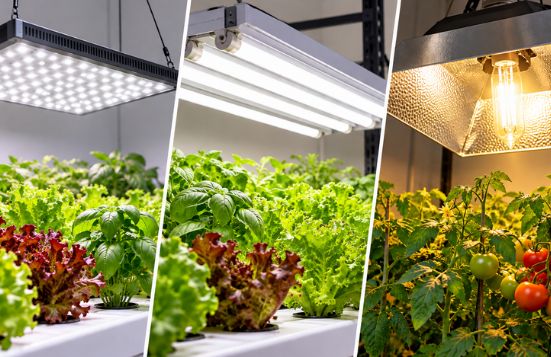

Choosing a grow light used to be one of the more confusing parts of setting up an indoor hydroponic garden. You had fluorescent tubes, metal halide bulbs, high-pressure sodium bulbs, different color temperatures, ballasts, reflectors, and plenty of other equipment to figure out.
Fortunately, things have gotten much simpler.
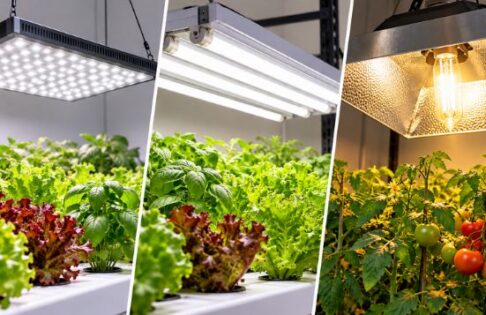
For most home hydroponic gardens today, a full-spectrum LED grow light is the best choice.
LED technology has improved dramatically while prices have come down. Modern LED grow lights are efficient, relatively cool-running, long-lasting, and available in sizes suitable for everything from a small lettuce garden to tomatoes and other high-light fruiting crops.
Other types of grow lights still exist—and some growers still use them—but if you’re building a new hobby hydroponic garden, there’s usually little reason to choose them over LED.
Let’s look at the options.
LED Grow Lights

LED (light-emitting diode) grow lights have become the standard choice for home hydroponic gardens, and for good reason.
Modern LEDs can produce large amounts of usable plant light without the excessive heat and energy consumption associated with many older grow-light technologies.
They’re also incredibly versatile.
A small LED fixture can provide plenty of light for lettuce, herbs, seedlings, and microgreens, while larger fixtures can provide the intensity needed for strawberries, peppers, tomatoes, cucumbers, and other fruiting plants.

| My Top Pick | 4,900+ Reviews |
Why LEDs Are the Best Choice for Most Hydroponic Gardens
LED grow lights offer several advantages:
- Energy efficient: More of the electricity consumed is converted into useful light rather than wasted as heat.
- Less heat to manage: LEDs still produce heat, but generally create fewer heat-management problems than HID fixtures.
- Long lifespan: Quality LED fixtures can operate for tens of thousands of hours.
- Full-spectrum options: One fixture can support plants throughout their growth cycle.
- No bulbs to replace: Unlike older grow-light systems, LEDs typically use integrated diodes rather than replaceable bulbs.
- Dimmable options: Many fixtures allow you to adjust light intensity as plants grow.
- Easy to use: Hang the fixture, set the appropriate height and intensity, connect it to a timer, and you’re ready to grow.
For a beginner, that last advantage is important.
You don’t need separate lights for vegetative growth and flowering. You don’t need to swap bulbs. And you generally don’t need to build a ventilation system specifically to deal with the heat produced by your grow light.
Beginner Tip: Don’t choose an LED grow light based on wattage alone. The amount of usable light reaching your plants—and how evenly that light covers your growing area—is much more important.
Fluorescent Grow Lights
Fluorescent grow lights, particularly T5 fluorescent tubes, were once extremely popular for indoor gardening.
And they still work.
 | My Top Pick | 1,800+ Reviews |
T5 fixtures provide relatively even light across a growing area and can be useful for:
- Seedlings
- Microgreens
- Lettuce
- Herbs
- Other lower-light plants

If you already own a T5 grow-light fixture, there’s no reason you can’t continue using it for appropriate crops.
The question is whether you should buy one for a new hydroponic garden.
In most cases, probably not.
Modern LED fixtures are generally more energy efficient, have longer operating lives, and are available in far more configurations. LEDs also make it easier to provide the higher light intensities needed for flowering and fruiting crops.
T5s aren’t bad grow lights. They’ve simply been surpassed by LED technology for most home hydroponic applications.
HID Grow Lights
High-intensity discharge (HID) lighting was once a major part of indoor gardening.
If you’ve been growing indoors for a long time, you’ve probably encountered metal halide (MH) and high-pressure sodium (HPS) grow lights.

These lights can produce a tremendous amount of light, and they can absolutely grow healthy, productive plants.
The problem isn’t that HID lighting doesn’t work.
It’s that modern LEDs can accomplish the same job much more conveniently for the average hobby grower.
HID systems typically involve more than simply hanging a light over your plants. Depending on the system, you may be dealing with:
- Replaceable bulbs
- Ballasts
- Reflectors or hoods
- Considerable heat
- Additional ventilation
- Higher electricity consumption
That made sense when HID was one of the best ways to produce extremely intense indoor lighting.
Today, a good LED fixture can provide high light levels without many of those disadvantages.
Metal Halide (MH)
Metal halide lights produce a spectrum with relatively strong blue wavelengths and were traditionally used during the vegetative stage of plant growth.
Growers often used MH while plants developed leaves and stems before switching to HPS for flowering.
High-Pressure Sodium (HPS)
High-pressure sodium lights produce light heavily weighted toward yellow, orange, and red wavelengths.
HPS became especially popular for flowering and fruiting plants because these fixtures could produce very high light output.
A traditional indoor growing setup might therefore use:
Metal Halide → Vegetative Growth
High-Pressure Sodium → Flowering & Fruiting
Modern full-spectrum LEDs have largely eliminated the need for hobby growers to use this two-light approach.
If you already own a functioning HID setup, you can certainly grow plants with it. But if you’re purchasing equipment for your first hydroponic garden, we don’t recommend investing in HID lighting.
LED vs. Fluorescent vs. HID Grow Lights
| Type | Best Use Today | Efficiency | Heat | Recommendation |
|---|---|---|---|---|
| LED | Almost any hydroponic crop | High | Low–Moderate | Best choice for most growers |
| T5 Fluorescent | Seedlings, greens and herbs | Moderate | Low–Moderate | Fine if you already own one |
| HID (MH/HPS) | High-intensity indoor growing | Lower than T5 & LED | High | Not recommended for most new hobby setups |
So, What Grow Light Should You Buy?
For most hobby hydroponic growers, the answer is simple:
Buy a full-spectrum LED grow light.
The more important question isn’t what type of grow light you should buy anymore.
It’s which LED grow light is appropriate for what you’re growing.
That’s where things like light intensity, coverage area, efficiency, hanging height, spectrum, and daily light requirements become important.
A light that works perfectly for a shelf of lettuce may be completely inadequate for a mature tomato plant. On the other hand, buying a powerful 400-watt fixture for four lettuce plants would be expensive overkill.
When choosing an LED grow light, consider:
- What plants you’re growing
- The size of your grow area
- How much light those plants require
- The fixture’s coverage area
- PPFD (light intensity at the plant canopy)
- Recommended hanging height
- Actual power consumption
- Dimming capability
- Heat and ventilation
- Fixture efficiency
You’ll also encounter terms such as PAR, PPF, PPFD, and DLI while shopping for grow lights.
Don’t let the alphabet soup scare you.
These measurements help describe how much useful light your plants are actually receiving. Once you understand the basics, they’re far more useful than simply comparing the wattage printed on the box.
The Bottom Line
Fluorescent and HID grow lights aren’t useless or incapable of growing plants. Plenty of successful indoor gardens have been grown under them.
Technology has simply moved forward.
For the average home hydroponic grower building a new system today, a quality full-spectrum LED offers the best combination of efficiency, light output, lifespan, heat management, and simplicity.
So rather than spending too much time deciding between different types of grow lights, start with LED.


Hi
What would the Best light be to use for flowering plants in a 3m x 3m x 2.4m grow space?
I would recommend some LED grow lights. They will show the coverage area on the specs. I think 2 1200 watt units should be enough to cover a space that size.
It is cool to learn these types led grow lights for indoor garden. What is the best one that you can suggest for budget of $1k?
Indoor gardening might be a great option for my uncle and he’s thinking of getting some hydroponic glow lights such as high-intensity discharge grow lights that you mentioned here because they’re warm. Maybe since he’s a starter, he should also go for compact fluorescent lights like you did because they save space. If we have all the options we can get from a store, I’ll ask him if he would rather prefer LED grow lights because they don’t use as much energy and is cost-effective like you said.
Thanks for stopping by Sariah! If you uncle is just wanting to grow leafy greens compact fluorescent’s work great. If he is going to want to grow fruiting plants I would suggest the LED route.