

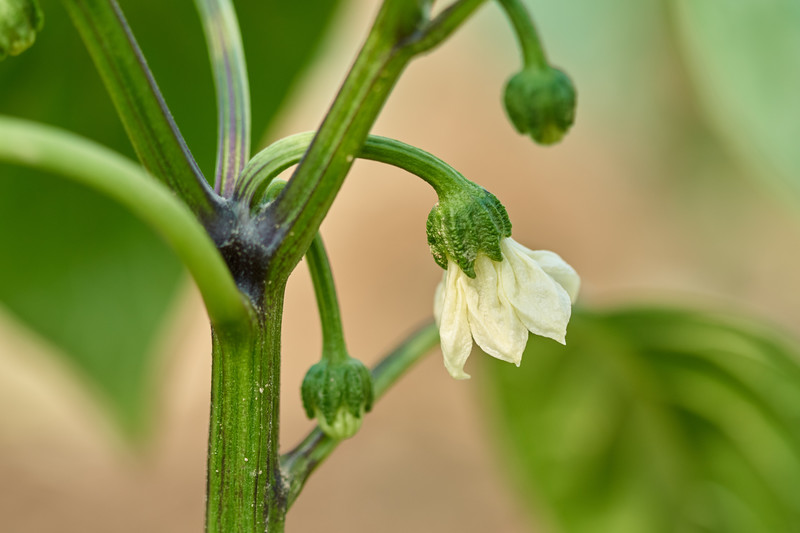

Seeing blossoms fall before they become tomatoes or peppers? You’re likely dealing with blossom drop. Luckily it’s both common and fixable! The guide below will get your garden back on track so your fruits set and you get a harvest.

What Is Blossom Drop?
Tomatoes and peppers are self-pollinating—every healthy flower is a potential tomato or pepper. When blossoms dry up and drop, pollen didn’t connect or the plant decided conditions weren’t good enough to carry a fruit. Fix the condition, and fruit usually follows.
Sanity check: some crops (like squash) have male flowers that naturally drop. Tomatoes and peppers don’t—so their falling blossoms are a red flag to troubleshoot.
Quick Troubleshooting Guide
Flowers dropping?
→ Start hand-pollination now for 3–5 days (it’s the fastest win).
Still dropping?
→ Lock in temps and humidity. That’s the #1 environmental cause.
Dropping still?
→ Swap to bloom nutrients and confirm pH/EC.
Haven’t stopped dropping??
→ Check for pests/disease, root-zone temperature/oxygen, and light heat at the canopy.
Pollination: Make Sure The Flowers Is Pollinated
Why it matters: Tomatoes and peppers don’t need bees, but they do need movement so pollen jumps from the anther to the stigma inside each flower. Indoors, fans sometimes aren’t enough—especially if humidity or temperature is off.
What to do:
- Vibrate clusters with an electric toothbrush against the stem for 1–2 seconds per cluster.
- Tap method: Flick/tap the main stem daily at midday when flowers are open.
- Air assist: Keep a small oscillating fan moving air through blossoms (gentle, not windburn).
- Optional brush: A tiny paintbrush flower-to-flower can help if you’re being precise.
- Skip misting blossoms: Water on petals can make pollen clump and tank fruit set.
How you know it’s working:
A light dusting of pollen (sometimes visible), flowers stay attached longer, and tiny green fruit begin to swell within a few days.
Related 🔗: Here’s 3 Different Methods of Hand Pollination
 | My Top Pick | 3,200+ Reviews |
Temperature: Stay In The Zone
Why it matters: Temperature impacts pollen viability and stigma receptivity. Too hot or too cold and pollination simply won’t be successful .
Targets: Days 70–85°F, Nights 60–70°F.
Avoid: Day >90°F or Night <55–60°F—either can tell the plant “not now.”
Peppers note: Peppers tend to be a bit pickier—try to stay closer to 70–80°F daytime if you can.
Fixes:
- Raise/dim lights, increase exhaust/INTAKE, and consider lights-on at night if your hydroponic room runs hot.
- In a greenhouse/outdoors, use shade cloth and vent early before heat builds.
- Watch night dips—a chilly garage or basement is a silent blossom killer.
Humidity: Pollen Needs To Stick
Why it matters: Pollen needs to release and then stick.
- Too dry (Low Relative Humidity): Pollen doesn’t stick to the stigma.
- Too humid (High Relative Humidity): Pollen clumps and won’t release.
Target range: 40–70% RH. For best results during active bloom, aim ~60% RH—right in the middle of the window.
Fixes:
- Run a small humidifier/dehumidifier to stay in range.
Nutrients: Too Much Nitrogen = Leaves, Not Fruit
Why it matters: Nitrogen builds leaves and stems; fruiting needs Phosphorus and Potassium to set and develop. High Nitrogen during flowering can look lush but stall fruit set.
Targets & tips:
- Switch to a bloom formula once clusters form (lower N, higher P/K).
- Avoid EC shocks: If you need to adjust EC, step changes gradually over 24–48 hours.
- Keep your pH around 6.0.
Related 🔗:
• 4 Best Hydroponic Nutrients for Beginners
• Understanding Hydroponic EC
• Top 5 pH Meters For Hydroponics
Airflow & Spacing: Let Flowers Breathe
Why it matters: Still, humid air around flowers blocks pollen movement and invites disease. Gentle, even airflow keeps pollen mobile and dries damp petals after watering.
What to do:
- Use a small oscillating fan to move air through—not at—flowers.
- Prune lightly for pathways of air and light; avoid stripping lots of leaves at once (stress).

| My Top Pick | 56,000+ Reviews |
Pests & Disease: Stressed Plants Don’t Set Fruit
Why it matters: Under attack, plants prioritize survival over reproduction. Even mild pressure can tip flowers over the edge.
What to check:
- Leaves (top & underside): speckling, chew marks, sticky residue.
- Roots: off-colors, slime, or funk.
- Stems & joints: webbing or tiny crawlers.
Good habits:
- Scout weekly, remove dead/dropped leaves, prune crowded growth.
- Sanitize tools and contact surfaces between runs.
- Treat early—“a few aphids” becomes a buffet quickly.
Related:
Root-Zone & Water: Where Problems Hide
Why it matters: Roots drive the whole show. Warm, low-oxygen water or big nutrient swings cause stress that shows up as… blossom drop.
Targets & tips:
- Water 65–70°F to keep dissolved oxygen high.
- DWC: strong aeration (lively bubbles). NFT/Drip: steady, oxygen-rich flow.
- Keep reservoirs shaded; avoid direct heat on buckets/totes.
- Top up thoughtfully and remix to avoid roller-coaster EC.
- Do: shade black buckets/totes and run pumps 24/7. Don’t: let the reservoir creep above ~72°F.
Light & Canopy Management: Bright, Not Broiled
Why it matters: Great light fuels fruiting, but excess intensity or heat at the canopy can damage delicate blossoms.
What to do:
- Raise or dim lights if you see tacoing leaves, bleached tops, or heat shimmer.
- Keep a consistent photoperiod (light on/light off period) and avoid dramatic pruning in one session.
- Support heavy clusters so stems don’t whip and pop flowers off.
Blossom Drop: Causes → Fast Fixs
- Poor pollination → Hand-pollinate 3–5 days; add a gentle fan.
- Heat/cold stress → Days 70–85°F; nights 60–70°F; shade/exhaust; prevent cold dips.
- Humidity off → Hold 40–70% RH; aim ~60%; increase canopy airflow.
- Too much nitrogen → Switch to bloom formula.
- Pests/disease → Sanitize, scout; treat promptly.
- Root stress → Water 65–70°F; more aeration/flow; stable EC.
- Light/handling → Raise/dim lights; support branches; gentle pruning.
Indoor vs Outdoor Quick Adjusts
- Indoor: Dim/raise lights, consider lights-on at night, add dehumidifier, boost exhaust, use a temp/RH controller.
- Outdoor/Greenhouse: Shade cloth, side vents/roll-ups, water earlier, and avoid heat-spiking the media.
Final Thoughts
Blossom drop feels discouraging, but it’s almost always a simple tune-up: give flowers a little movement, keep temps and humidity in the sweet spot, switch to a bloom-leaning feed, and make sure roots and airflow stay happy. Focus on the new blossoms after you dial things in—you’ll usually see tiny fruit start to swell within days. Keep your checks quick and consistent, and this won’t turn into a season-long mystery. You’ve got this—small tweaks now, fresh tomatoes and peppers soon.


Hi Michael:
Just read your info about tomato plants dropping blossoms because that is exactly what is happening to mine. I have gone down the list of possible causes and come up short. Yet common sense says there has to be a reason. My plants we’re growing rapidly to the point I just had to prune them to tame the growth down a little. I use General Hydroponic bloom series for my nutrients and the lights are Mars Hydro. Some are in the flood and drain system and some DW system. So I’m stumped. Do you have any other hints on this situation. Thanks.
Wally.
Hey Wally,
I wouldn’t have any other guesses besides the ones offered without knowing a little more. If temperature, humidity, and nutrients are all correct I would try to pollinate the flowers more.
Michael:
Thank you so much for taking the time out of your busy schedule to reply to my inquiries. It is greatly appreciate. I am happy to report that two of my three hydroponic tomato plants have started to produce. Perhaps the pruning has helped this. At any rate, I am very happy with that. And as usual your site continues to provide much helpful information on many hydroponic matters. Again, thank you and have a very safe and happy Christmas.
Sincerely;
Wally.
Hey Wally, I find it interesting that you are using a Mars Hydro. I too have a mars Hydro, TS600 to be exact. A few months ago, I got rid of a few DWC hydro peppers because I thought they had pest problems and my only budding plant kept dropping every bud. Fast forward to about a week ago and I moved my only remaining outside plant indoors. Previous to being moved inside, the plant had one pepper growing which is still growing. Since moving it inside, being placed under the Mars Hydro grow light, and repotted, it has dropped about 6 flowers which I have hand pollinated several times. Maybe I have been stressing the plant or maybe the mars hydro is not suitable for flowering plants.