
Hydroponics skips the dirt—but not the food. Since there’s no soil for roots to pull nutrients from, you provide everything directly in the water. The good news? Modern nutrient lines make it easy. With a simple feeding chart and a few checks, you’ll be mixing like a pro in no time.
📝 Quick How-To: Feeding Hydroponic Plants
- Pick your nutrients – Start with a single-part solution for simplicity.
- Mix with water – Follow the label’s feeding schedule (they’ve done the math).
- Check pH – Adjust pH to between 5.5–6.5 so plants can absorb nutrients.
- Adjust strength – Seedlings ~25% strength; established plants 75–100%.
- Swap formulas if needed – Veg favors nitrogen; bloom favors phosphorus & potassium.
What Exactly Are Hydroponic Nutrients?
Hydroponic nutrients are concentrated mineral salts dissolved in water—the same essential elements plants would pull from soil, delivered straight to the roots.
- Macronutrients: Nitrogen (N), Phosphorus (P), Potassium (K)
- Secondary nutrients: Calcium (Ca), Magnesium (Mg), Sulfur (S)
- Micronutrients: Iron, Zinc, Copper, Manganese, Boron, Molybdenum
Which Hydroponic Nutrients Are Best for Beginners?
There’s no single “best” brand. Choose based on how simple you want the process to be and the type of plants you’re growing.
✅ Single-Part Nutrient Solutions (Most Beginner-Friendly)
- One bottle does it all—just measure, mix, and grow.
- Great for leafy greens and herbs.
- Examples: Superthrive Grow (all-in-one).

| My Top Pick SuperThrive Foliage Pro Hydroponic Nutrients | 600+ Reviews |
⚙️ Multi-Part Nutrient Systems (More Control, Slightly More Work)
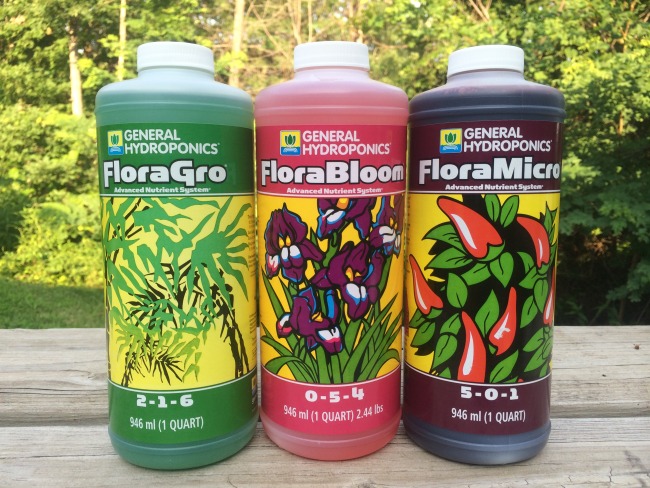
- Usually 2- or 3-part (e.g., “Grow,” “Micro,” “Bloom”).
- Lets you tweak ratios for veg vs bloom—useful for fruiting crops.
- Popular pick: General Hydroponics 3-part system Flora Series.
 | My Top Pick | 7,500+ Reviews |
🌱 Pro Tip: First grow? Use a single-part nutrient. Once you’re comfortable, try a 3-part to fine-tune yields on tomatoes, peppers then more advanced crops.
Understanding N-P-K Ratios (Without the Jargon)
Every nutrient bottle lists three numbers—the N-P-K ratio:
- N = Nitrogen → leafy growth (lettuce, basil, spinach)
- P = Phosphorus → roots & flowers
- K = Potassium → overall health & fruit quality
Example: 10-5-14 means 10% nitrogen, 5% phosphorus, 14% potassium.
- Vegetative stage: choose a formula higher in nitrogen (N).
- Flowering/fruiting stage: switch to higher phosphorus & potassium (P/K).
How to Use Hydroponic Nutrients (Step-by-Step)
- Start with water in the reservoir (preferably filtered or tap rested 24 hrs).
- Add nutrients to water (not water to nutrients). Measure carefully.
- Follow the feeding chart from your brand. It tells you how much and when.
- Check pH and adjust to 5.5–6.5 for most crops.
- Set strength by stage: seedlings ~25%; veg 50–100%; bloom per chart.
- Top off with plain water between changes (water evaporates, salts don’t).
- Refresh the reservoir every 1–2 weeks to avoid imbalances or slime.
Common Beginner Mistakes (and Easy Fixes)
Overfeeding: Burnt tips and crispy edges = too strong. Fix: Dilute to 75% or flush and remixed.
Ignoring pH: Nutrients can be present but unavailable. Fix: Check pH whenever you top off or change solution.
Mixing out of order: Some multi-part lines need a specific order. Fix: Follow the label exactly.
Never changing the reservoir: Salts build up, pH drifts. Fix: Refresh every 1–2 weeks.
No top-offs: Water goes down, EC goes up. Fix: Add plain water to your fill line between changes.
Hydroponic Nutrients FAQs
Do I need special hydroponic nutrients, or can I use regular fertilizer?
Use hydroponic-specific nutrients. They’re balanced for water systems and designed to stay dissolved and available to roots.
How often do I “feed” hydroponic plants?
In most systems, roots sit in the solution so they’re “fed” constantly. Follow the brand’s schedule and refresh every 1–2 weeks.
What’s the most affordable option for beginners?
Single-part nutrients are cost-effective and low hassle. You can upgrade to a multi-part later for more control.
Do nutrients change by plant type?
Yes. Leafy greens thrive on veg-type formulas. Fruiting plants (tomatoes, peppers, strawberries) do better with a bloom formula during flowering.