


Choosing the right light spectrum is one of the three core basics of plant lighting (the others being intensity and duration). It sounds technical, but it doesn’t have to be.
Here’s the short version:
Plants don’t care about brand names or fancy marketing—only the colors of light they receive.
Let’s break it down in a way that actually helps you grow better plants without overthinking it.

| My Top Pick | 4,900+ Reviews |
Quick Answer: Grow Light Basics
If you want a simple rule that works for most hobby hydroponic gardens:
- ✅ Use a full-spectrum LED grow light
- ✅ Run it for 14–18 hours (depending on plant type)
- ✅ Don’t worry about switching LED grow lights for different stages
Modern LEDs already handle this well. Now let’s explain why that works.

Why Light Spectrum Matters
Sunlight looks white—but it’s actually made up of many different colors, each with a different wavelength.
Plants use these colors to fuel photosynthesis, the process that turns light into energy.
Different colors = different jobs.
The Light Spectrum Is for Plant Pigments
Plants absorb light using pigments—special molecules that capture certain wavelengths and reflect others (which is why plants look green).
The main pigments involved in photosynthesis are:
- Chlorophyll a
- Chlorophyll b
- Carotenoids
Each pigment responds best to specific parts of the light spectrum.
Plants use mostly blue and red light, but they benefit from more than just those two colors.
What Each Light Color Does for Plants
Blue Light (400–500 nm)
- Drives leafy growth
- Encourages compact, sturdy plants
- Critical for seedlings, clones, and vegetative growth
Red Light (600–700 nm)
- Promotes flowering and fruiting
- Helps regulate plant size and maturity
Far-Red Light (700–800 nm)
- Supports flowering signals
- Improves canopy penetration in mature plants
White Light (Full Spectrum Blend)
- Contains blue, red, and green wavelengths
- Easier on your eyes
- Makes plant issues easier to spot
Why LED Grow Lights Are the Best Choice for Hydroponics
LED grow lights dominate modern hydroponics for good reason:
- Energy efficient (lower electric bills)
- Low heat output
- Long lifespan
- Custom spectrum control
Unlike older lighting types, LEDs can deliver only the wavelengths plants actually use—without wasting energy.
 | My Top Pick | 1,300+ Reviews |
Do You Need Different Lights for Veg and Flower?
Short answer: No.
Most modern LED grow lights are full spectrum, meaning:
- One light works for the entire plant life cycle
- No bulb swapping
- No spectrum guesswork
Some LEDs include switches or dimmers, while others run all spectrums all the time. Both approaches work well for hobby growers.
Why Some Grow Lights Look Purple (and Others White)
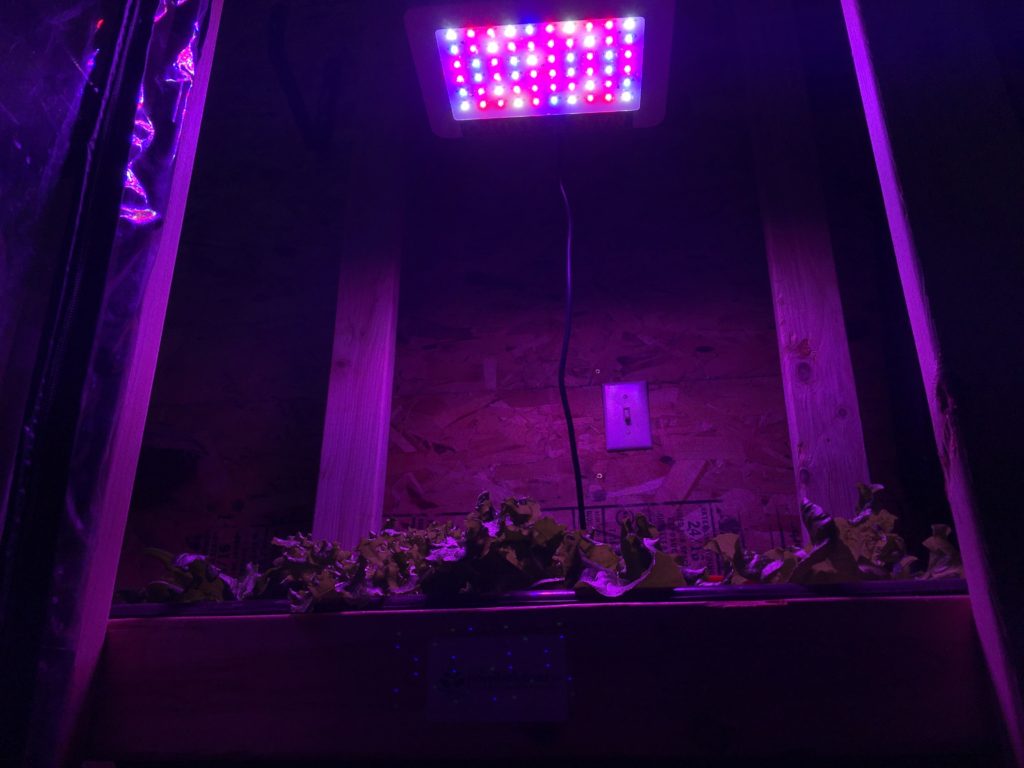
Older LED grow lights often looked purple because they used mostly red and blue diodes.
Newer LEDs include more green and white light, which:
- Looks closer to natural daylight
- Makes it easier to inspect plants
- Produces better photos and videos
Plants don’t care which one you choose—your eyes do.
Fluorescent & HID Grow Lights: How Spectrum Works There
Unlike LEDs, fluorescent and HID lights don’t emit individual colors. Instead, they’re measured using Kelvin (K)—a scale that describes the overall color temperature of the light.

Vegetative Growth
- 5,000–7,500K
- Cool, blue-heavy light
- Ideal for seedlings, clones, and leafy growth
Flowering & Fruiting
- 2,000–3,000K
- Warm, red-heavy light
- Encourages blooms and fruit development
If you’re using HID lighting:
- Metal Halide (MH) → veg
- High-Pressure Sodium (HPS) → flower
This is one of the reasons LEDs have largely replaced HID for hobby growers.
Beginner Tip: Don’t Overthink Spectrum
Here’s the honest truth:
Light intensity and distance matter more than obsessing over exact wavelengths.
A decent full-spectrum LED, placed at the right height, will outperform a “perfect spectrum” light that’s too weak or too far away.
Frequently Asked Questions (FAQ)
Do plants need different light colors at different stages?
Yes—but modern full-spectrum LEDs already provide them, so you don’t need to change lights.
Is purple light better than white light?
No. Plants grow just as well under white full-spectrum LEDs. White light is simply easier for humans to work under.
Can plants grow under regular LED shop lights?
Yes, especially leafy greens—but they’re less efficient and usually lack enough intensity for fruiting plants.
Does UV light help plants grow?
In very small amounts, it can influence plant responses, but it’s not necessary for successful hydroponic gardening.
Final Thoughts
Choosing the right light spectrum doesn’t need to be complicated.
For most hydroponic gardeners just use a full-spectrum LED at the correct height and a consistent light schedule. That’s it.
Get those right, and your plants will do the rest.


Your explanations are very concise and easy to understand, thank you.
I was hoping to find a one-size-fits-all answer for what color light to use thru all stages. I don’t need seedling lights, so just blue for vegetation and red for flowering.
I’ve read that white lights don’t provide a wide enough spectrum, but now you said that that there are other colors in white light that my plants need.
Please help! Should I use red/blue OR white LEDs?
Hi Rhonda, most LED lighting that is full spectrum will come with a mixture of red, blue, and white LED’s. I’ve had really good results growing both lettuce and peppers with my MarsHydro LED grow light.
I have a 5’ plus ficus I put outside in summer. I don’t have indoor lighting to keep it going. I do have a 4 light grow light. Is the red/blue setting good for my ficus?
Hey Donna! It sounds like you have a full spectrum grow light offering both the blue and red spectrum which should work for your ficus.
Thank you for your interesting site. I am brand new to all of this. I got a small African Violet plant last spring, and it produced many beautiful flowers. Then this fall I put clear plastic over its window ( to save on my heating bill), and all of the flowers died although the leaves still look very healthy. Now as winter deepens, I see that my violet isn’t getting much sun. I’m on a very tight budget and can’t afford to buy much new lighting. For the last few evenings, I’ve set my plant under a table lamp with approximately a 60 watt led bulb. Will this help my violet at all? It’s planted in soil. I hope to learn more about your method in the future. Thank you, Susan
Thanks for the feedback Susan! I’m happy you found my article helpful. LED light bulbs will work depending on the bulb. For vegetative growth, plants should be under bulbs with a color temperature between 5000K and 6500K.
I am new in the plant world and gonna try growing flowers from seed over the winter. I purchased LED 4000 lumen/5000k cct daylight. Will this work to grow strong healthy seedlings?
That should work to start some seedlings. Just don’t keep the light too close to them.
I have LED grow lights with 3 colors that each have an on off switch. My question is, for flowering plants should I use just red or red and white or red, white and blue?
I would check the manufacturers recommendations but my guess would be to use all three switches. Plants will need all three of those colors during the flower stage.
Thank you for the tip about tearing off a bit of the pod to cover the seeds. My intuition was that dropping seeds into the holes was suboptimal. I used an opened paper clip to tear new smaller holes and poked my seeds into those.